

Accredited e-learning courses for continuing education in psychosocial oncology (WPO)
Date
Written by
Emily Finke
Reading time
4 min.
Projects
Accredited e-learning for continuing education in Psychosocial Oncology (WPO) – cross-site, interdisciplinary, effective
Nationwide, many locations, different prior knowledge levels: For WPO, we developed three e-learning modules that deliver the theoretical foundation consistently. All three modules are accredited by the Baden-Württemberg Chamber of Psychotherapists. The result: better preparation, greater depth in in-person events, and a cross-site standard of quality and knowledge in curriculum implementation.
Initial situation & target vision
WPO offers its continuing education programs nationwide. In the WPO-IC curricula (interdisciplinary) and WPO-PT (licensed psychotherapists), professional groups with highly heterogeneous prior knowledge learn together: physicians, psychotherapists, and social workers. Many instructors contribute their expertise—valuable, but complex to coordinate.
Target vision:
Cross-site consistent theoretical foundational knowledge before course/in-person days
High didactic quality despite heterogeneous prior knowledge levels
Accreditability for official recognition of continuing education hours
Didactic approach
Didactic reduction & clear learning objectives
We structure content around precise learning outcomes (knowledge, application, reflection). Complex content is didactically reduced without losing professional depth.
Modular & microlearning-capable
The modules are divided into short, self-contained units. This facilitates asynchronous learning and promotes repetition, transfer, and retention.
Interactivity & assessment
Knowledge checks (formative assessment)
Blended learning approach
E-learning serves as preparation for course dates
Low-barrier design
Calm, clear UI, unambiguous text-image references, consistent typography, and lean navigation minimize cognitive load.
Technical implementation
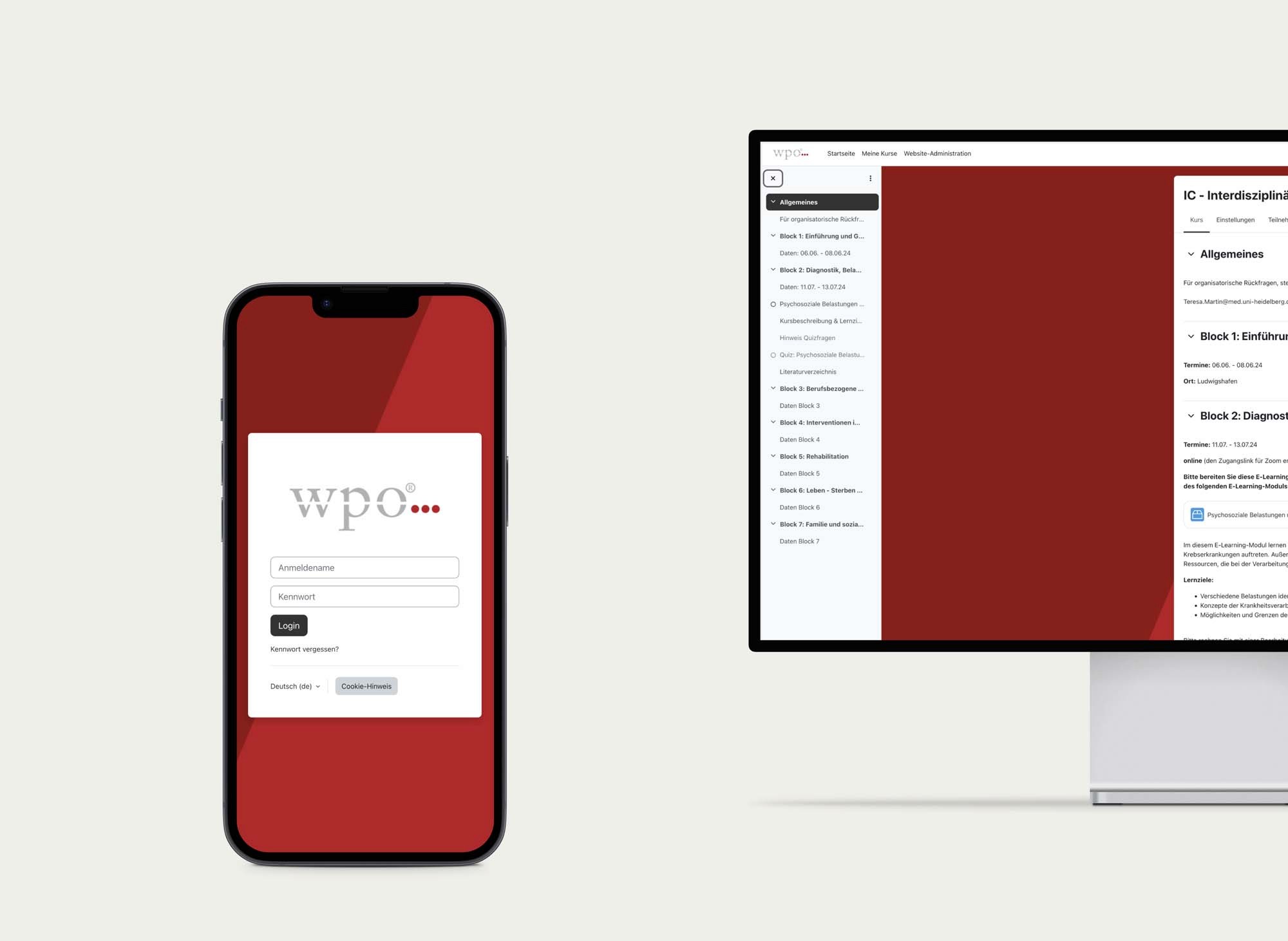
Moodle integration
Roles & permissions tailored to target groups and instructors
Tracking & analysis for course leadership and quality management
Stable scalability for nationwide use
Quality assurance
Subject-matter copyediting and editorial loops with instructors
Iterative prototypes until consensus on content, tone, and depth
Module overview
Introduction to psycho-oncology and psycho-oncological care – accredited
Foundation of terms, roles, care structures, and interdisciplinary interfaces.
Psychosocial burdens and coping with cancer – accredited
Stress factors, coping, indicators for interventions, interprofessional collaboration.
Guidelines and quality assurance in psycho-oncology – accredited
Guideline orientation, quality assurance, documentation.
Added value of accreditation: Psychotherapists receive continuing education credits. PT chambers generally mutually recognize completed courses—so participants benefit nationwide.
Why accredited e-learning?
Quality standard: Uniform knowledge base across all locations
Efficiency: In-person time for deepening instead of fundamentals
Motivation: Continuing education credits as a clear incentive
Transparency: Learning objectives, scope, exams, and proof are clearly defined
Collaboration & process
Kick-off & goal definition (curriculum mapping, target groups, recognition criteria)
Content framework & storyboards (sequence, media, checks, cases)
Prototyping (UI/UX, tone, exemplary learning units)
Expert reviews with instructors (multi-stage coordination)
Production (text, graphics, interactions, audio/video optional)
QA & copyediting (technical, linguistic, didactic)
Moodle integration (roles, tracking, reporting)
Rollout & monitoring (support with technical questions & development of new solutions in expanding the LMS platform)
Rollout & monitoring (feedback loops, optimization)
Impact in the curriculum
Consistent foundation for all participants – regardless of location and prior knowledge
Greater depth in discussions & exercises during in-person sessions
Visible quality promise through accreditation
Better controllability for course leaders thanks to reporting
Examples of learning elements
Visualization of abstract concepts
Complex issues broken down to their core statement
Graphic/interactive preparation
Definition of key technical terms
Audience-oriented wording and examples
Consideration of and resolution of possible misunderstandings
Promotion of individual deepening in various subject areas
Undisturbed learning path without distracting information, for a clear overview
Reference to further information tailored to the interests of target groups
Measurable results (examples)
High completion rates even when offered for voluntary completion
Positive participant feedback on comprehensibility and relevance
Outlook
Development of additional modules
Expansion of the learning platform to further support course operations
Continuous content updates in line with guideline developments
Key takeaways
Heterogeneous target groups? → Clear overview through e-learning modules that fit perfectly into the blended learning concept
Many locations? → Uniform foundation, better use of in-person sessions
Quality & incentive? → Accreditation + credits increase motivation
Would you like to standardize curricula across locations and build accreditable e-learning?
Then feel free to contact us!


