Team Talk with Laith - Multimedia Communication & Documentation
Date
Written by
Emily Finke
Reading time
8 min.
splendid Team Talk
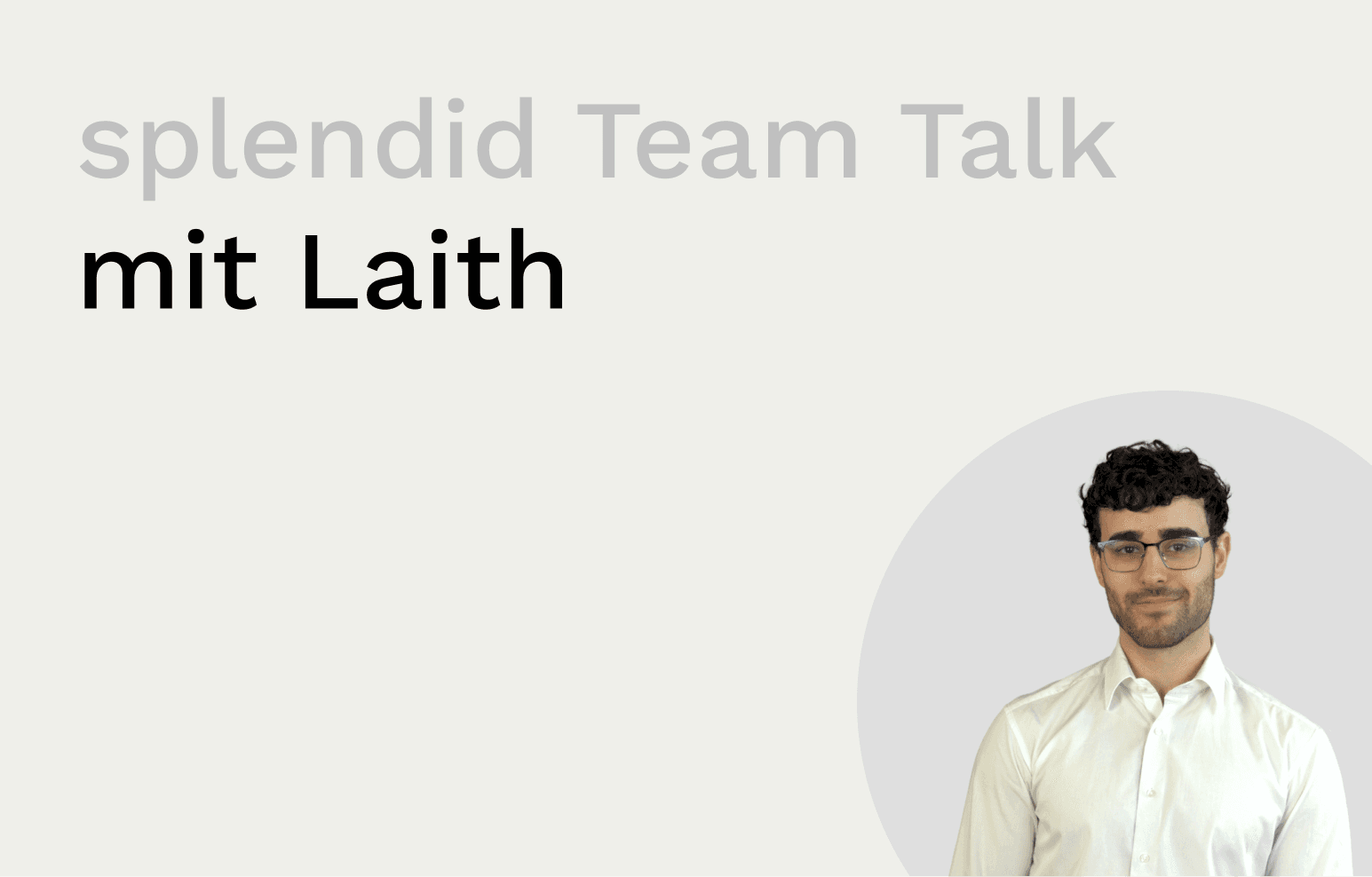
Laith recently joined the splendid learning team as a working student in Web Design & Development. He is studying Multimedia Communication & Documentation at TH Aschaffenburg (soon entering his 4th semester) and brings an exciting mix of technology, communication, and a UX perspective. In the Team Talk, he shares how he came to splendid, what he is working on during onboarding (including his first redesign project in Framer), and why one thing matters most to him in day-to-day work: reducing complexity and making user guidance clear.
Laith, briefly introduce yourself: Who are you, what are you studying, and what do you do at splendid learning?
“My name is Laith, I’m 22 years old, and I study Multimedia Communication and Documentation – entering my fourth semester in mid-March. At splendid learning, I’m a working student in web design and development.”
Why Multimedia Communication & Documentation – what appealed to you about it?
“What appealed to me most was how interdisciplinary the degree program is. The mix of technical, media, and business modules gives you a very broad foundation, and that was a major plus for me.”
What led you to splendid learning – and why a working student role in web design & development?
“I was looking for a working student position in UX and/or web development. During that process, I came across splendid through a Google search. When I saw the website and the areas of work, I immediately knew: I have to apply there – because it was exactly what I had been looking for.
I wanted to move toward web design and development because user experience is very interesting to me. And I also found the Web Technologies 1 and 2 modules at university very appealing.”
What was important to you when choosing a company?
“It was important to me that I could really get involved and not just be given the tasks nobody else wants to do. I want to learn hands-on and truly expand my knowledge and skills.”
What are you learning in your studies that specifically helps you in web design and development?
“What helps me most is audience-oriented communication from the communication modules, because it automatically makes you think more from the user’s perspective. In the course ‘User Experience in Technical Documentation,’ the focus is specifically on really putting yourself in the user’s shoes. And through Web Technologies 2, I’ve also gained practical experience with programs like Figma.”
Is there a module or topic that especially excites you right now?
“As I said, UX is really exciting me right now. Aside from that, I also found the Web Technologies, Mechanical Engineering, and Design modules very interesting. I’m also really looking forward to the fourth semester, because modules like UX Design Project, Project Management, and Quality Management are coming up.”
How would you explain ‘Multimedia Communication & Documentation’ to someone who has never heard of it – in one sentence?
“Explaining my degree program is nothing new for me – because I usually only get confused looks when I say that I study Multimedia Communication and Documentation. Either people can’t imagine what it is, or they just hear the word ‘media’ and tune out right away. It gets even better when I then talk about modules like Mechanical Engineering or Digital Twin – then I often hear: ‘I thought you were studying something with media?’
It’s hard to explain in one sentence, but if I had to, I’d say:
The degree program combines technology and communication and serves as the interface between technical content and the people who are meant to understand and use it.”
What role do communication and technology each play in it?
“Communication and technology go closely hand in hand in this degree program.
Technology provides the content foundation and understanding of systems, while communication ensures that this content becomes audience-appropriate, understandable, and usable.”
What are you currently working on, or what are you starting with during onboarding?
“My onboarding initially started with getting familiar with the program Framer and immediately with a small project so I could become familiar with the interface and functions.
After that, I already received my first real project: a redesign of the foodsharing Hanau website. I started in Figma to develop the right structure and layout. Right now, I’m in the process of implementing everything in Framer.
To be able to really contribute as quickly as possible, I also started the Google UX Design Certificate on the side.”
Which tools/processes were new to you, and which did you already know?
“I was already familiar with Figma, Notion, and Canva. Framer was the only new tool for me.”
What kind of tasks do you enjoy most: UI/design, structure/UX, implementation/frontend, or debugging?
“I currently enjoy UX structure and frontend implementation the most. I like thinking about how users move through a page and then really bringing that concept to life in the frontend. You can directly see the result of your work.”
What do you especially want to dive deeper into over the next few months?
“I’d like to master Framer and Figma even better and, of course, complete the Google certificate to gain an even better understanding of UX.”
From your perspective, what is the biggest challenge in web design & development – especially in the day-to-day of client projects?
“I’d say the biggest challenge is reducing complexity. Many projects start with lots of ideas and content, and the task is then to develop a clear and intuitive structure from all of that. In the end, it’s about working out what really matters and giving users orientation.”
Is there a typical mistake many people make?
“People often try to fit in too many features or too much content. That quickly leads to overloaded pages that feel cluttered. In doing so, you keep realizing: less is often more – especially when it comes to clarity and user guidance.”
What surprised you in your first days with us – positively or unexpectedly?
“The family-like atmosphere and being directly involved in real projects surprised me very positively. I was also given a lot of freedom while getting familiar with Framer – I found that very pleasant.”
What helped you most when settling in?
“Everyone is incredibly accommodating. If I have questions, I know I can approach someone at any time.”
What does good onboarding look like to you? What should every team do so new people become productive quickly?
“An open, welcoming atmosphere, getting to know the team and the different areas of work – and at the same time, a certain degree of freedom. In my opinion, that also leads to becoming productive more quickly.”
What was especially helpful for you here?
“In my first project, which was meant to help me get to know Framer better, I was initially given a lot of freedom. If I got stuck, I sat down with Luca and we discussed everything.
This mix of independent familiarization and the meetings with Luca really helped me a lot.”
Which first projects or tasks at splendid learning are you most looking forward to?
“I’m most looking forward to more web projects and to continuing the certificate.
Basically, I’m looking forward to everything where I can learn new things and apply them right away.”
What would you like to have ‘in your toolbox’ by summer?
“A better awareness of UX and more confident handling of the most important programs like Figma and Framer.”
How do you create balance away from the screen? (Sports, volleyball, piano)
“I do sports six to seven times a week – so almost every day. My plan includes strength training at the gym, endurance sports like cycling or swimming, and club volleyball. If I feel like doing something different, I also enjoy playing the piano.”
Do you have a routine that helps you stay focused?
“I wouldn’t call it a fixed routine, but rather an attitude. I keep my goal in sight: to keep learning and growing. That mindset helps me not lose focus.”
If you had to describe your first month at splendid learning in three words – what would they be?
“Accommodating, hands-on, and team – that describes it quite well.”