

Team Talk with Jacqueline - Advanced Training "Specialist in Digital Media with AI & Web Development"
Date
Written by
Emily Finke
Reading time
6 min.
splendid Team Talk
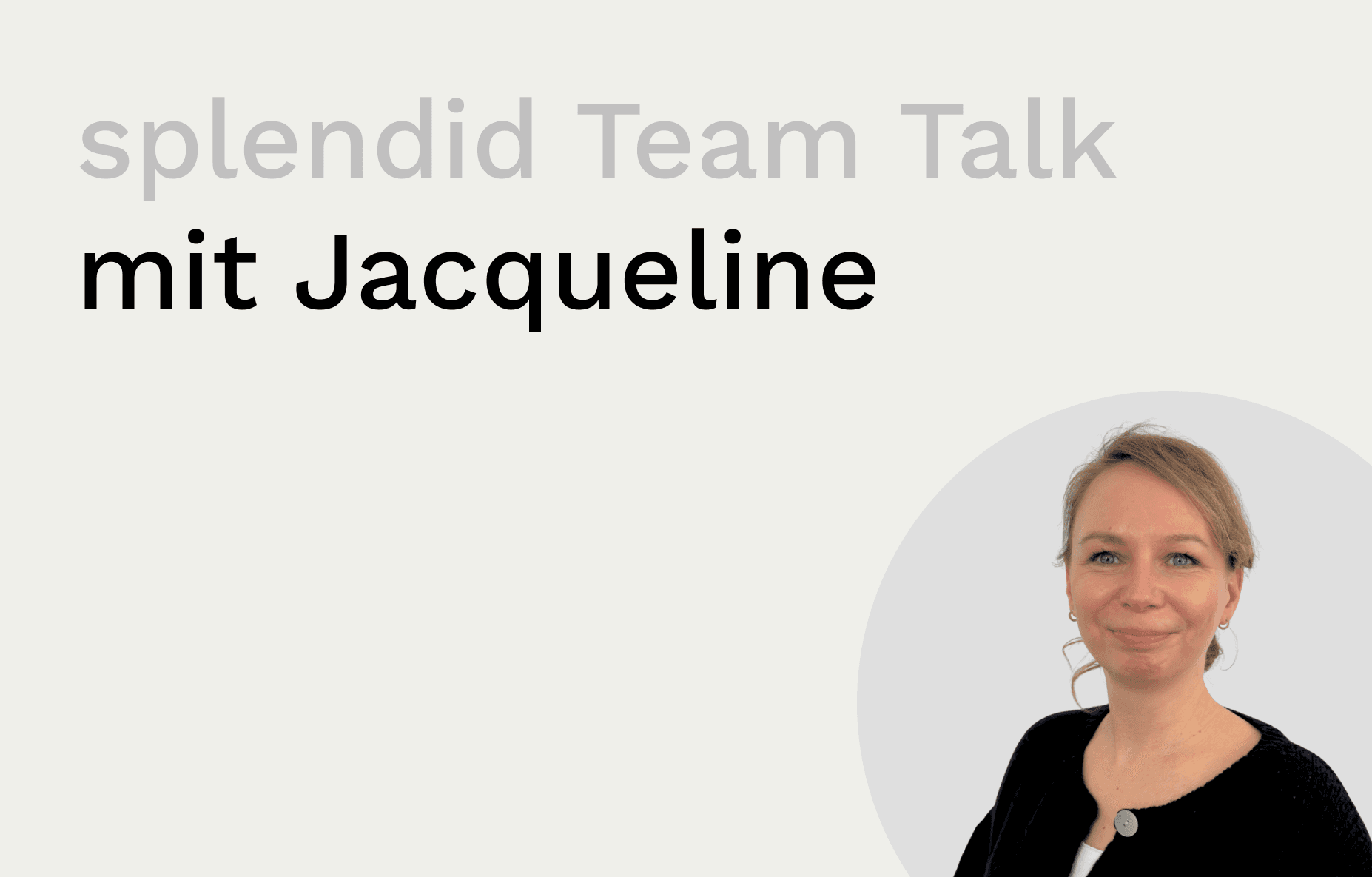
Jacqueline has been part of the splendid learning team since August 2025 and primarily works with us in Learning Design. At the same time, she is completing a one-year advanced training program to become a “Specialist for Digital Media with AI & Web Development” at Bildungsinitiative Deutschland. In the team talk, she discusses what transitioning into digital communication feels like, which topics she is currently learning, and how she applies this new knowledge directly to her projects—including a critical perspective on AI in everyday life.
1. Jacqueline, you’ve just started a new training program—what was the trigger?
“I’m entering the field of digital communication as a career changer. A lot is still new to me and was quite hard to understand at first. But that’s exactly what makes getting started exciting: I learn something new every day, discover new connections, and notice how I become more confident step by step. What appeals to me is working my way into a completely new field and continuously developing along the way.”
2. If you had to summarize the training in one sentence—what is it really about?
“That’s impossible in just one sentence. Over the past seven weeks, I’ve been introduced to an intensive mix of very different areas: from self- and project management to data processing and competitive analyses, all the way to digital identities and tools like Canva, Figma or N8N. It was an enormous range that showed me how diverse digital communication really is. And this is only the beginning. The training will also cover topics such as content creation, graphic, photo, and video production, building your own website, as well as the relevant legal foundations, data protection, and ethical issues. For me, this is an exciting opportunity to build a comprehensive understanding of the digital world and to establish myself in it professionally step by step.”
3. You’re mainly involved in Learning Design at splendid learning — what exactly do you do?
“I especially enjoy developing interactive elements. I like preparing learning content so that it’s not only informative, but also actively involves and motivates participants. I particularly enjoy working on interactive elements because they make learning a bit more lively. I also like the QA phase, because I can calmly test whether everything works properly and is built coherently.”
4. Why is this training such a good fit for your role right now?
“The training fits my role very well right now because I have at least six training calls every week—always with different instructors and participants. Everyone brings their own topics, which we break down together until it’s truly clear what it’s about. In the process, I not only see how differently people learn, but also how differently instructors convey content. This diversity shows me every day how broad and exciting learning can be—and that’s exactly what the training captures perfectly.”
5. Which topics are on the curriculum—and which ones grabbed you already in week 1?
“The curriculum is really extensive—the training runs for a full year. Everything is new to me, and that’s exactly why a lot of it grabbed me right in the first week. I try to absorb everything like a sponge, because it’s simply exciting to see what is possible in this field.”
6. AI is part of the title—how is AI addressed in the training?
“AI is treated very practically in the training. For example, we learn how important a well-formulated prompt is and what a difference it makes when you describe precisely what you expect from AI. At the same time, it also becomes clear that while AI is a helpful tool, you should always critically review the results. The systems are constantly evolving, and not everything they output is automatically correct. For me, it’s therefore a mix of toolset and sense of responsibility: use AI meaningfully, but always with a vigilant eye.”
7. How can AI concretely help in Learning Design—without quality suffering?
“AI can support Learning Design well without compromising quality—especially in tasks like research, improving texts, or building a meaningful structure. I like using AI for these steps because it makes the process faster and clearer. I would consciously avoid AI as soon as personal or sensitive data is involved. In those cases, it’s important to me to check everything myself and not put information into systems that are not suitable for it.”
8. Which learnings do you want to immediately bring into ongoing projects?
“I want to bring many of the topics directly into ongoing projects. Above all, my goal is to deliver better quality with the new programs and methods. For me, that also includes formulating clearer learning objectives so the content is structured even more precisely. At the same time, I enjoy trying things I’d never heard of before and integrating them into my work step by step.”
9. You’re also learning about media campaigns—what does that mean for learning products?
“Media campaigns help structure learning products so they are not only well designed, but also truly found and used. With funnel thinking, you look at the learners’ entire journey: a clear landing page that explains the learning product, short social snippets that spark interest, and a logical transition into the course. This creates a learning product that is not only convincing in terms of content, but also intentionally guides learners to where they should begin.”
10. What is, in your view, the biggest misconception around “AI will handle it”?
“For me, the biggest misconception is believing that AI automatically provides the best or right solution. Since working with it, I’ve realized how important my own judgment remains—especially with sensitive topics. AI can make suggestions, but it doesn’t understand which nuances matter or which wording might come across as inappropriate. That’s exactly where human experience, empathy, and the ability to see what truly fits are still needed.”
11. Which skills remain timeless in digital communication—no matter how smart the tools become?
“In digital communication, there are skills that always remain important regardless of new tools or trends. This includes a genuine understanding of the target audience—knowing what moves people, how they absorb information, and what appeals to them. Good storytelling and a clear structure are just as timeless, because they make every message easier to understand and more memorable. Didactic thinking and thoughtful UX also remain central, because they ensure content is logically structured and feels intuitive. These fundamentals support every form of communication, no matter how much technology evolves.”
12. How do you organize learning alongside a full-time job?
“I organize my learning alongside my full-time job mainly through a mix of routine and commitment. On the one hand, I have to stay on track because the Bildungsinitiative monitors progress—on the other hand, I genuinely enjoy constantly learning new things. Still, it is of course demanding. The content builds on itself logically, but just because I’ve seen something once doesn’t mean I understand it immediately. That’s why I review many things multiple times and sometimes also use the weekend to work on practical assignments.
What helps me: I can ask questions in the calls at any time or even book one-on-one sessions, which is incredibly valuable. And my team supports me completely—if I say I need learning time, it’s not up for debate. This mix of structure, support, and genuine interest keeps me going.”
13. What would be a good result after 3 months—and how would you notice: this is really making a difference?
“A good result after three months would be noticing that I can truly transfer what I’ve learned into my daily work. For example, if a specific process runs faster or more cleanly because I apply new methods—whether in structuring content, planning small media campaigns, or creating learning materials. I would also notice it by needing to look things up less and becoming more confident in my decisions. So if I have a clear use case where I can say: I wouldn’t have been able to do this three months ago, then I know it’s really making a difference.”


