

SEO for Social: How Your Posts Rank Like Mini Landing Pages
Date
Written by
Emily Finke
Reading time
4 min.
Knowledge
You know the scene: You publish a strong carousel on Instagram or a well-founded LinkedIn post. The first few hours go well—then the curve flattens. Two days later, the content has disappeared from the feed.
What if your post does not end up in oblivion—but is found via Google for months?
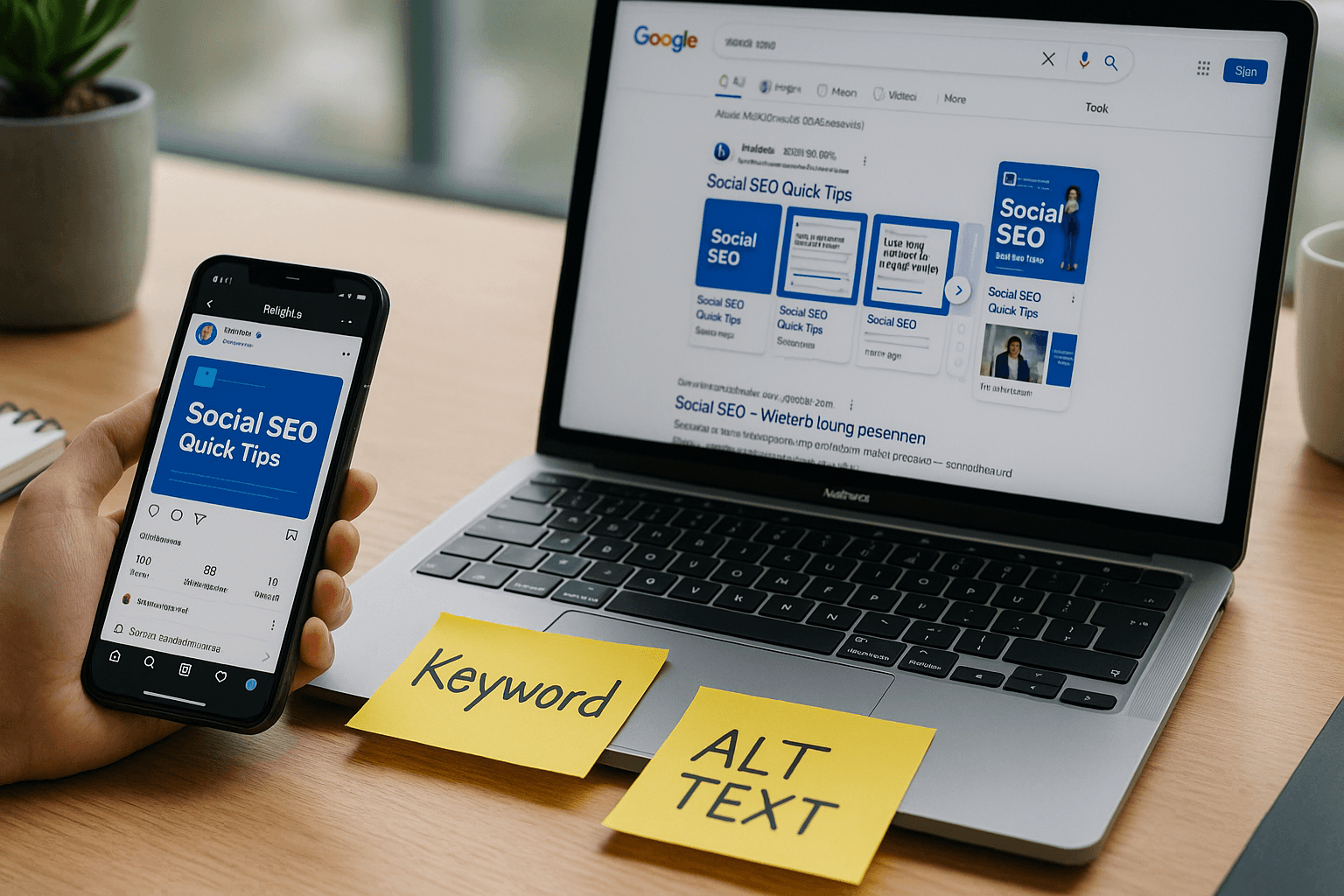
This is exactly where Social SEO comes in: Treat every post like a mini landing page—with clear search intent, a visible keyword, alt text, embedding on your website, and clean UTM links. This makes social content discoverable, understandable, measurable.
1) Mindset: A post is more than a snippet—it is a mini landing page
Search intent first: What question are you answering? (e.g., “How do I optimize Instagram posts for Google?”)
One main keyword + 1–2 synonyms: e.g., Social SEO, Instagram SEO, LinkedIn SEO.
Hook = title: The first line of your caption is your “H1”: short, precise, click-worthy.
Example hook: “Social SEO: How your posts rank like mini landing pages.”
2) On-post SEO: Write for people, optimize for machines
Put the keyword up front: In the first 120–150 characters of the caption.
Maintain alt text (Instagram): Describe what can be seen and why it is relevant (accessibility + context).
Niche hashtags instead of generic ones: 3–8 tags that are truly close to the topic.
Location & mentions: Capture local searches and partner signals.
Rule of thumb: Clarity beats keyword density. Your language stays human—the structure helps machines.
3) Format signals: Dwell time is the new currency
Carousels increase dwell time and saves.
On-screen text reflects your keyword (title in the image = additional signal).
Clear CTA: “Save,” “Comment,” “Link in bio/profile”—specific instead of vague.
Series logic: Part 1/3, Part 2/3 … Internal linking contributes to discoverability.
4) The bridge to the open web: Embedding beats one-off content
Platform posts are often poorly indexable. Solution: Make your website the home of the content.
Blog snippet (150–300 words) for the post: Brief intro, key points, embed the Instagram/LinkedIn post.
Add UTM links to your bio/profile links so you can clearly see user paths (e.g.,
utm_source=instagram&utm_medium=social&utm_campaign=social_seo).Clean metadata on the website:
og:title,og:description,og:image, fast mobile loading time.
Effect: Google finds the blog article (canonical), the social content is embedded and remains discoverable—weeks and months later.
5) Practical story: An Instagram carousel becomes long-term Google traffic
Starting point:
A B2B team posts an Instagram carousel on “5 quick wins for LinkedIn SEO”. Good reactions in the feed, but after 48 hours everything flattens out.
How to make it social-SEO-proof:
Hook first: “LinkedIn SEO: 5 quick wins for more visibility.”
Alt text for each slide: concise image description + benefit (“Slide 2: Put the keyword at the start of the headline …”).
Niche hashtags: #LinkedInSEO #SocialSEO #B2BContent
Website snippet: 200-word blog post with a short example, carousel embedded, OG tags maintained.
UTM link in the bio (“Read more in the blog”).
Internal linking: From the blog to a guide page (“Social SEO Guide”)—and back to additional carousels.
Result: After 2–3 weeks, the blog post gets its first Google impressions for the keyword “LinkedIn SEO quick wins”; traffic remains steady. The previously fleeting carousel becomes a lasting search entry point—without ads.
6) “Will my content show up in ChatGPT & co.?”
There is no classic ranking for ChatGPT. AI assistants prefer to reference public, trustworthy sources.
What you can influence:
Create indexable content on your website (blog + embedded social post).
Structure clearly: clean headings, Schema.org where useful, understandable titles.
Build reputation: Mentions/backlinks on reputable domains, consistent brand signals (website, LinkedIn, Google Business Profile).
In short: Optimize for the open web, not for a single model. Then your chances of appearing as a source in AI answers also increase.
7) 20-minute workflow for your next post
Define keyword & search intent.
Write the hook (first line = title).
Build the carousel (5–7 slides, clear progression).
Write alt text (concise, context-rich).
Set hashtags/location/mentions.
Create blog snippet, embed the post, check OG tags.
Use UTM link, track analytics.
Plan the series (tease Part 2/3).
Conclusion: Visibility is not a coincidence—it is a system
Social SEO means designing content so that it guides people and is understood by machines.
With a clear hook, visible keyword, good alt text, and the bridge to your website, a fleeting post becomes a lasting touchpoint.
This creates organic reach without ads—and your content works for you longer.
Do you want to establish Social SEO as a repeatable process in your team—including hook formulas, alt-text guidelines, UTM conventions, and a template for blog snippets?
Write to us. We adapt the system to your CI, tools, and goals—so your posts don’t fizzle out, but perform.


